• Tuesday 18 July 2006
    Highlights: Trakai Castle, The moving Hill of Crosses

    On the way to Latvia in the morning we visited Trakai (Lithuania).   This is the site of a stunning old castle.   The defences of this place are amazing; they had at least 4 different sections they could fall back into.   The castle dates from the 14th century and actually never fell to an enemy. Trakai Castle was the capital of the former Grand Duchy which ruled this area.   One of the best castles I’ve seen in Europe.

    On the way into Riga we stopped at the Hill of Crosses which represents those who died or disappeared between 1940 and 1989.   Under the USSR the displays were pulled down periodically but locals kept coming back.   A lot of the crosses only have birthdates as no one knows the exact death dates for those who disappeared.
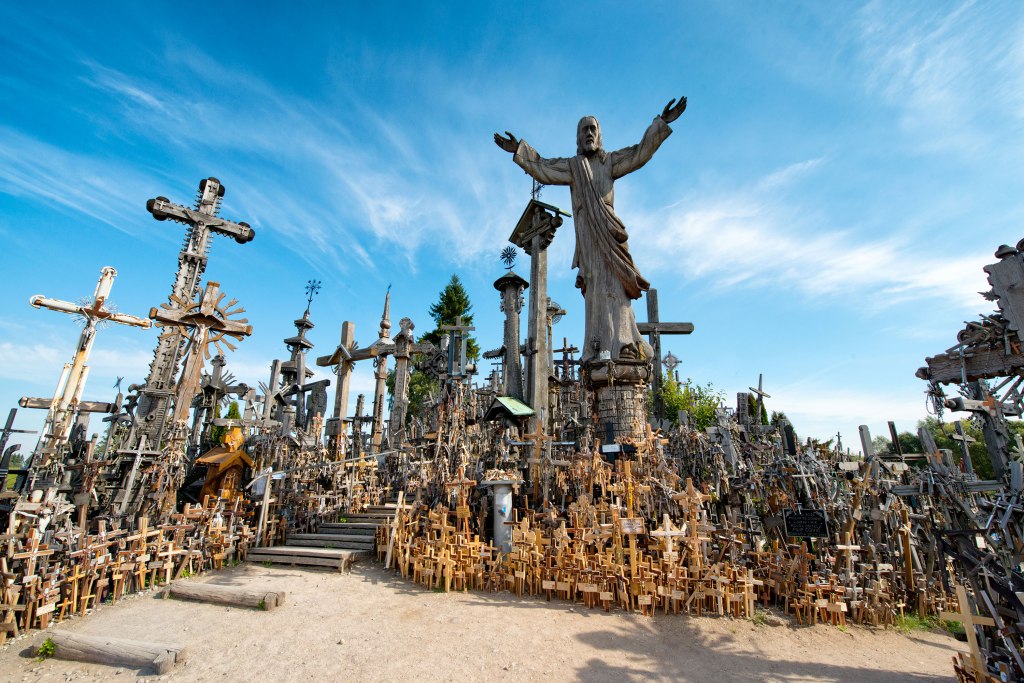
    hill-of-crosses-lithuania

  • Monday 17 July 2006
    Highlights: Gediminas Square, St Peter & St Paul Church

    We left the dark and dreary Belarus for the more energetic Lithuania which is the first of the Baltic States and a former republic of the USSR (Belarus is not Baltic and wants to be a republic again).  

    The first thing you get from this place is just how much people are bitter at the former USSR.   Over 25% of the population was lost in WWII and in many ways the country is still suffering from this and the efforts of communism up until 1989. Lithuania was the first ‘republic’ to declare independence from the USSR and at first suffered for this declaration (this was 2 years before the breakup of the USSR).

    Lithuania however did enjoy a good period of independence between the two World Wars. Vilnius has embraced the capitalist world these days.   The busy streets are full of traders is probably the best demonstration of this fact.   Highlights during the day included; St Peter & St Paul Church and the Jesuit University.   In Gediminas Square I stood on the stone / step that says if you make a wish it might came true, we will see!

  • Sunday 16 July 2006.
    Highlights: Buying Beer from Government Shop!

    Belarussia President Lukashenko certainly runs this country in and interesting fashion.   While Russia and other countries around have taken great steps forward this President has managed to only move the country a little bit past the USSR era which he longs for a return to.

    In order to do this tour you need to come through this country, as a result of this, and the need for hard currency (yes it is that bad) the Belarussia government charge you $61 USD for your visa and crossing from Russia to Belarussia felt like a step back in time. It was intriguing to see a country that was close to the old communist system.  

    The local hotel was very basic (but one of the best here), which was fine for me after all the hostels I’ve stayed at, but some on the trip were not impressed (our tour guide had warned us from the start). I went for a walk around the city and you can see that the current system is hurting the locals.   BTW you can only buy beer from the Government, and they say that State Government’s in Australia rely on ‘sin’ taxes too much!

  • Saturday 15 July 2006
    Highlights: Borodino Panorama Exhibition, The Kremlin

    We started off by visiting the Borodino Panorama Exhibition.   This exhibition highlights the 1812 war with France and in particular a key battle about 100 kms outside of Moscow.

    (more…)

  • Friday 14 July 2006
    Highlights: Moscow Red Square, Cathedral of Christ the Saviour

    The Moscow Red Square, site of all those army marches I still remember as a child.   Today I got to visit this incredible place which included Lenin’s tomb just outside the Kremlin. It’s hard to take in just how much world history has come from this place.   St Basil Cathedral has to be one of the most famous sites in the world.

    An unusual feature of the square is no venders are actually allowed inside it (they are however at the gates).   One of the walls of the square contains a fantastic shopping mall (and that is saying something from me!), Stalin must be rolling in his grave as you can buy all the latest fashions.   I’m not sure how the locals can buy from this place however given the prices.

    I also got to see other famous sites in Peter the Great Statue and the Cathedral of Christ the Saviour.   This place is amazing; I think I’m falling in love with this city.   Everyone should visit.

    259526_10150219441920685_4744244_o

  • Thursday 13 July 2006
    Highlights: Moscow Metro System

    Setting off from Novgorod we briefly stopped at the small town of Volga which highlighted how the majority of people live outside of St Petersburg and Moscow.   The roads are not very good, it takes a lot longer to travel distances in Russia for example one 200 km stage of the day took 3.2 hours.   It much cost their economy a fortune as trucks can’t go the speed limit, I think the country would get a great efficiency dividend by fixing the main roads.   It was many hours of being bumped all over the place. We are staying at a upper class hotel, “Sovietsky” which like most hotel’s doesn’t have air conditioning but otherwise is probably the best one I’ve stayed at.

    Tonight we went on a tour of the Metro system.   The communist certainly know how to build grand projects when they wanted to.   At times you would think you are in a museum.   The photos I took don’t do it justice.   The trains themselves are cheap (about 6 roubles or 25 cents AUD) and they go very fast (about 100 km/h between stations). At the end of the tour we briefly saw the outside of the Kremlin and Red Square however they were closed due to a concert just finishing.   Heaps of troops obviously helped with the crowd.

  • Wednesday 12 July 2006
    Highlights: Hermitage art collection (St Petersburg), Kremlin Fort (Novgorod)

    On our last day in St Petersburg we visited the Hermitage art collection.   Started by Catherine the II (the Great) as her personal art museum in a structure linked to the winter palace it now covers the entire palace area. The collection is the best I have ever seen (yes including the Louvre).   The only reason it isn’t known by most people in the West is due to the Soviet era restrictions and you still have to jump through hoops to get a visa (however it is worth it for this place alone).

    The paintings by Leonardo Da Vinci are worth a look, but so too are the sculptures and state rooms.   I was very impressed.   The palace square was also stunning; Peter the Great had a great vision for this city when he created it.

    256006_10150219428590685_7695811_o


    In the afternoon we left for Novgorod and on arrival did a city tour.   Highlights include the Millennium Monument (for Russia), the Kremlin Fort, and St Sophia Cathedral, which is the oldest in Russia (but was having reconstruction work done). Novgorod was initially the biggest city in Russia.   Ivan the IV (the Terrible) however almost destroyed it completely due to their independence (and democracy arrangements).   During World War II the town was occupied by the Germans and in the fighting the town lost over 250,000 residents which is more than the current population.

    Novgorod

  • Tuesday 11 July 2006
    Highlights: St Isaac’s Square & Cathedral, Eternal Flame, Yusupov’s Palace

    After the very big day of yesterday I had scheduled a tour of Yusupov’s Palace which was the home of Felix Yusupov and his noble family. Three months before the revolution on 16th December 1916 Felix conspired to kill the infamous Rasputin.   Rasputin believed in sinning (mostly though sex, apparently he organised orgies) and repenting bought you closer to god.   He had a lot of influence of the Romanovs (Tsars) which caused public unrest and also with the nobles as he was a commoner.

    (more…)

  • Monday 10 July 2006
    Highlights: Pushkin Palace (Summer Palace), Petredvoert (Versailles of Russia), Attending the ballet – Swan Lake

    This morning I visited what is now know as the Pushkin Palace (after famous Russian poet) but was the former Summer Palace of the Tsars.   This palace was occupied by the Nazis in WWII and severely damaged, so much so that they are still fixing this palace. The palace is incredible, especially the architecture.   The Romanovs (Tsars) spared no expense building this place.   In fact they hired the best artist etc from Western Europe or sent locals to Rome to study and came back and build this place.

    Peter the Great loved Western Europe which is why he built St Petersburg to get Russia closer to Europe.  In the afternoon I visited Petredvoert which was a summer residence of Tsar Peter the Great and has been compared to Versailles in France (which I think is a fair comparison).   The grounds are breathtaking.   In summer the fountains are a sight to behold.

    They don’t use pumps but instead nature via water pressure, a brilliant design. In the evening I attended a ballet, Swan Lake, and I was very impressed.   I go to the theatre usually a few times a year, and I actually saw my first Opera overseas in Vienna, but the ballet might have to become a regular event for me.   The theatre wasn’t air conditioned (and the day got to 35 degrees) but I still loved the performance.   Apparently the ending of Swan Lake can vary but tonight we got the happy ending.

  • Sunday 9 July 2006
    Highlights: Peter and Paul Fortress

    With a 6 am wakeup call and an excellent buffet breakfast (I might like touring after all!) we were off to Russia. Passing the border was an interesting experience, first you go through the Finland border (which didn’t take long), then you enter a sort of no man’s land, and then through to the Russian border (which took longer but wasn’t bad).   On the Russian side of the border heaps of trucks were waiting to be cleared, our guide Ilya (who was born in Russia) said once there was a 20 km line of trucks to get out!

    We got into St Petersburg in the late afternoon we got to visit the Peter and Paul Fortress which was really the founding point for this city.   We visited the Cathedral and visited the tombs of the Tsar’s including Nicholas II and his family.

    Peter and Paul Fortress
    Peter and Paul Fortress