
Official Name: Republic of Türkiye
Established: 29 October 1923 (Ottoman Empire 1299)
Population: 85 million (2023 estimate)
Religion: Muslim (99.8%)
Language: Turkish
Capital: Ankara
Order of Visit: 72
First Visit: 30 April 2023
Last Visit: 07 June 2023
Duration: 14 Days
Highlights:
Istanbul – Exploring the historic Fatih district, Exploring the Basilica Cistern, Visiting the Grand Bazaar, visiting Tekfur Palace, Cruising the Bosphorus Strait, Egyptian Spice Bazaar, The New Mosque (1665), Exploring the Sultan Ahmed Mosque (Blue Mosque), Exploring Topkapi Palace, Climbing Galata Tower, Exploring the Hagia Sophia
Gallipoli Peninsula – Gabatepe Beach, ANZAC Cove, Ari Burnu Cemetery, Lone Pine Cemetery and Memorial, 57 Piyade Alayi Sehitligi (Turkish 57 Regiment) Memorial, Chunk Bair (site New Zealand Memorial)
Ayvalık – Exploring Troy, Exploring archipelago Ayvalık Islands
Selçuk – Exploring Izmir, exploring Ephesus ruins in depth, visting the ancient Library of Celsus, Visiting Şirince Village, Visiting St John’s Basilica, Enjoying a Wine Sampling afternoon
Pamukkale – Hierapolis Ruins, White travertine terraces, Cleopatra Antique Pool, Whirling Dervishes Ceremony
Cities visited: Istanbul, Gallipoli Peninsula, Canakkale, Troy, Ayvalik, Izmir, Ephesus, Bergama, Selcuk, Pamukkale
Published: 06 March 2023 | Updated: 19 June 2024
Location and Geography
Türkiye is a transcontinental country with a population of 85 million people and an area of 783,356 square kilometres located between Europe and Asia.
Türkiye borders the Black Sea to the north; Georgia to the northeast; Armenia, Azerbaijan, and Iran to the east; Iraq to the southeast; Syria and the Mediterranean Sea to the south; the Aegean Sea to the west; and Greece and Bulgaria to the northwest.

History and Culture
One of the world’s earliest permanently settled regions, present-day Türkiye was home to important Neolithic sites like Göbekli Tepe, and was inhabited by ancient civilizations including the Hattians, Hittites, Anatolian peoples, Mycenaean Greeks, Persians and others.
The Seljuk Turks began migrating to what is now known as Türkiye (then referred to as Anatolia) in the 11th century. The Seljuk Sultanate of Rum ruled Anatolia until the Mongol invasion in 1243.
Beginning in the late 13th century, the Ottomans united the principalities and conquered the Balkans, while the Turkification of Anatolia further progressed during the Ottoman period. After Mehmed II conquered Constantinople (now Istanbul) in 1453, Ottoman expansion continued under Selim I. During the reign of Suleiman the Magnificent, the Ottoman Empire became a global power.
From the late 18th century onwards, the empire’s power declined with a gradual loss of territories. The Young Turk Revolution of 1908 restricted the authority of the Sultan and restored the Ottoman Parliament after a 30-year suspension, ushering the empire into a multi-party period.
The Ottoman Empire entered World War I as one of the Central Powers in 1914. After its defeat in the war, the Ottoman Empire was partitioned. The Turkish War of Independence against the occupying Allied Powers resulted in the abolition of the Sultanate on 1 November 1922, the signing of the Treaty of Lausanne (which superseded the Treaty of Sèvres) on 24 July 1923 and the proclamation of the Republic on 29 October 1923.
Türkiye joined NATO in 1952. During the Cold War years, the country endured two military coups in 1960 and 1980, and a period of economic and political turmoil in the 1970s. The economy was liberalized in the 1980s, leading to stronger economic growth and political stability. Since 2002, the country’s political system has been dominated by the AKP and its current leader Recep Tayyip Erdoğan first as Prime Minister and later as President after he centralised power into that role.
Türkiye is a charter member of the United Nations, the IMF and the World Bank and joined the EU Customs Union in 1995, and started accession negotiations with the European Union in 2005 but several EU members have concerns about expanding so far and across into Asia.
Türkiye is divided into seven geographical regions: Marmara, Aegean, Black Sea, Central Anatolia, Eastern Anatolia, South-eastern Anatolia and the Mediterranean. The coastal areas of Turkey bordering the Aegean and Mediterranean Seas have a temperate Mediterranean climate, with hot, dry summers and mild to cool, wet winters. Far from the coast the climate of Turkey tends to be continental but elsewhere temperate, and has become hotter, and drier in parts.
Most of the provinces and regions in Türkiye are vulnerable to earthquakes with devastating earthquakes in February 2023.
What drew me to visit Türkiye?
Türkiye is a very unique country on the edge of two major areas in Europe and Asia, with the Bosphorus Strait splitting the continents. Türkiye has a fascinating history in particular the Ottoman Empire era.
My research highlighted many great and stunning historical sites I’m looking forward to exploring in particular Troy and Hierapolis. As an Australian a visit to the Gallipoli battlefields is almost a rite of passage.
This visit is in two parts, the first is a quick 8 day tour titled The Best of Turkey, I’ll then visit Central Asia and return for a 5 day stay in Istanbul to give me a chance to explore the history of this city in detail.

My extended time in Istanbul, previously called Constantinople, which was for a time the capital of the Roman Empire, later Eastern Roman Empire aka the Byzantine Empire, should be amazing.
What I experienced in Türkiye
I found Türkiye to be a real marvel of a country. Ancient ruins, bustling markets, unique food, and stunning landscapes. Türkiye was everything I was hoping for and more.
As an Australian travelling the world a visit to Gallipoli Peninsula is almost a must. Visiting the many cemeteries and seeing the memorials was almost a spiritual experience. Sad but also inspired by those who gave their lives, not for a cause but for their mates. This was on both sides of the conflict. War shows the worse side of humans, but occasionally it shows our spirit. There should never have been a war here, and definitely not the huge loss of lives that occurred. We need to remember what happened, not for the glory of war but to show the cost and why it should be avoided if at all possible.

Visiting the ruins of Troy and learning the history of this location that goes far beyond the myths and stories makes this history more real to me. Exploring ancient civilisations show us some much of ourselves, how far we have come, but also the family and friendship connections are a universal need across human history.
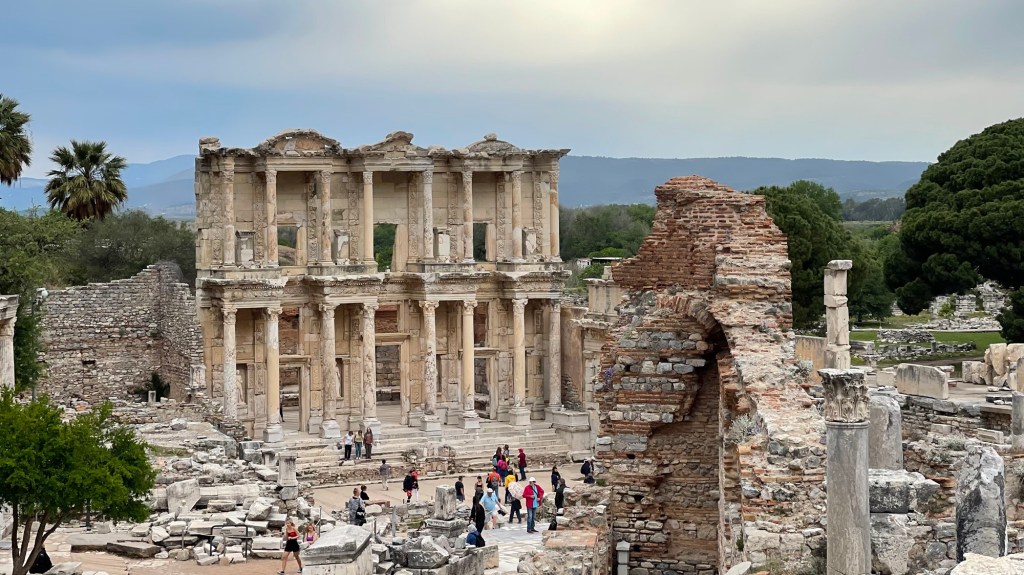
Exploring the amazing Ephesus ruins in depth was a highlight of not just Türkiye but all ancient sites that I’ve explored. The ancient Library of Celsus, the greatest storage of knowledge in the ancient world for a long time, was awesome inspiring. Walking in the Parliament meeting forum I could almost imagine the debates. I felt the same walking and exploring the massive theatre that could hold 25,000 people, highlighting another universal experience, people want to be entertained in groups as a shared experience.
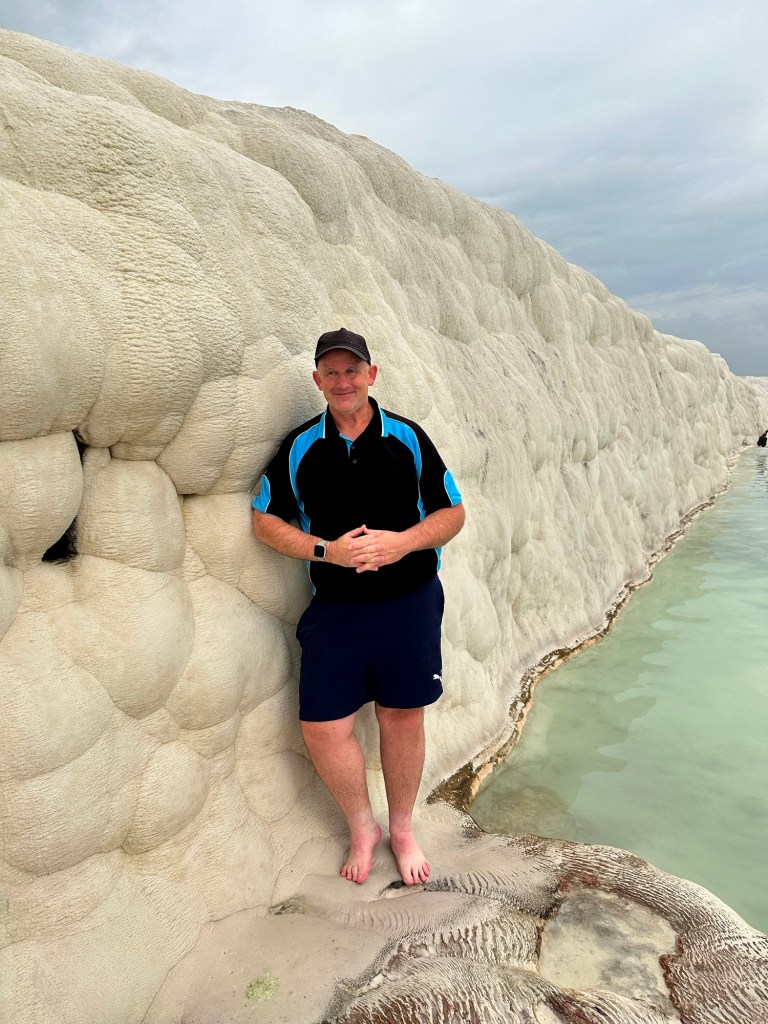
For landscape the white travertine terraces at the Hierapolis Ruins was a unique sight. This site also let me explore and experience the magnificent Hierapolis theatre plus swim in the Hierapolis Cleopatra Antique Pool rumoured to cure illnesses. Swimming over fallen Roman columns was not something I ever thought I would do.
Which bought me to the capital Istanbul which I visited three times during my World Trip 2023. This historic city on the edge of Asia and Europe had marvels on almost every corner (and happy street cats!). I was very glad I knew to visit the Basilica Cistern, this underground former water storage site was a beautiful structure. It highlights that you never know what is underground.

Religion is a major focus of ancient sites in Istanbul, in particular the previously Christian religious sites build when the city was Constantinople and under the Eastern Roman Empire but later converted into Mosques under the Ottoman Empire. The Sultan Ahmed Mosque (Blue Mosque) and Hagia Sophia are must dos.
Istanbul is also about shopping. I found the Grand Bazaar to live up to its name. Worth visiting is the Spice Market and the many carpet shops and more minor markets.
Visiting both Tekfur Palace and Topkapi Palace assisted me in understanding the power that the rulers of this time had. The gardens, displays and the view from Topkapi was a major highlight.
Cruising the Bosphorus Strait allowed me to get a unique view of this city on the crossroads of Europe and Asia.
Re-reading my journal entries and revisiting photos from this trip trigger many positive memories. I’d strongly recommend Türkiye as a place to visit and I now know there is a lot more still to explore.
 Nathan's Insights
Leave a comment