
Sunday 08 April 2024
Highlights: Brandenburger Gate, Memorial to the Murdered Jews of Europe, The Canals of Berlin, the stunning Berlin Cathedral, visiting the remaining section of the Berlin Wall, exploring an underground bunker.
Today our Tour CEO Christin kindly offered a tour of Berlin that wasn’t part of the official G Adventure tour. Originally this extra was to take 1 to 1.5 hours but Christin kept expanding it as we asked questions. Most of the group started this unofficial morning tour but only 5 remained for the entire walk.
Utilising the train system of Berlin we started at Brandenburger Gate, not far from the German Parliament (aka the Reichstag building). The Brandenburger Gate was built from 1788 to 1791 by order of King Frederick William II of Prussia.

During the Cold War the gate was obstructed by the Berlin Wall, and was for almost three decades a marker of the city’s division. It is now the site of unity and peace.
From here we moved on to the Memorial to the Murdered Jews of Europe site. It was opened on 10 May 2005 and is a place to remember the six million Jewish victims of the Holocaust.
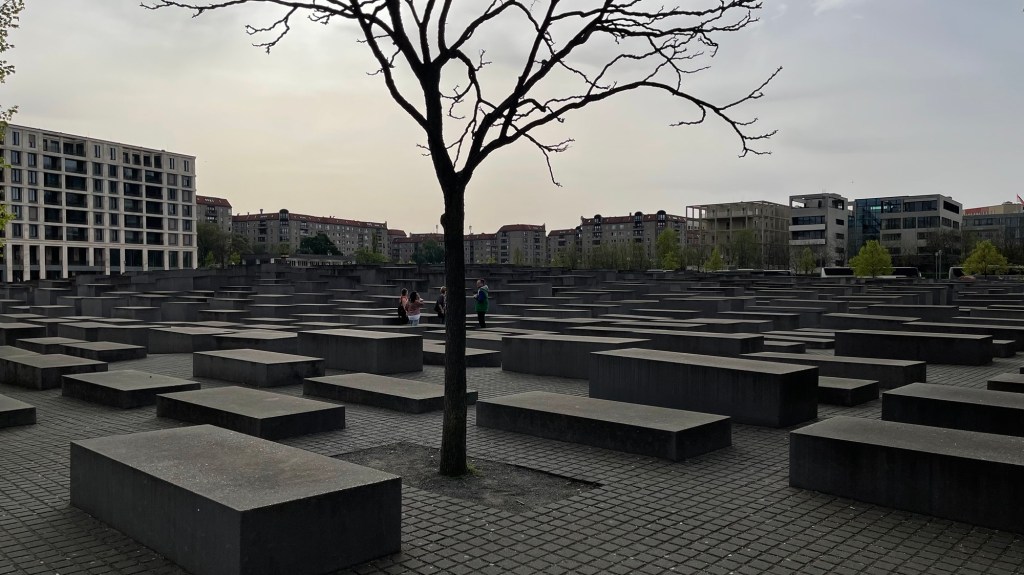
We continued to move around this area and visited the US Embassy to looked at the Berlin Bear turned into a Statue of Liberty, we also saw displays of the famous East Berlin red and green walking signs and many historical buildings not destroyed in the Allied bombing and attacks. Although there were a lot of Soviet designed and built apartments in the East Berlin side.
Always moving is the Memorial for the Nazi Book burnings. It is here that Heinrich Heine’s famous 1821 quote “Where they burn books, they will, in the end, burn human beings too” comes to mind, especially as his books were also burned on this site by the Nazi regime on 10 May 1933. This was a few years before the burning of Jews commenced by the Nazi regime in 1941.

We moved on still admiring the buildings around us and headed towards the massive and magnificent Berlin Cathedral that was not destroyed by the World War 2 bombings. To get there we passed over a Berlin Canal. The Canal looks very peaceful now, but during the Cold War this waterway separated loved ones between East and West Berlin with people dying in attempting to cross.

We also visited the Fernsehturm (East Germany Television Tower) and the Berlin Council Building followed by the Urania World Clock located in public square of Alexanderplatz.

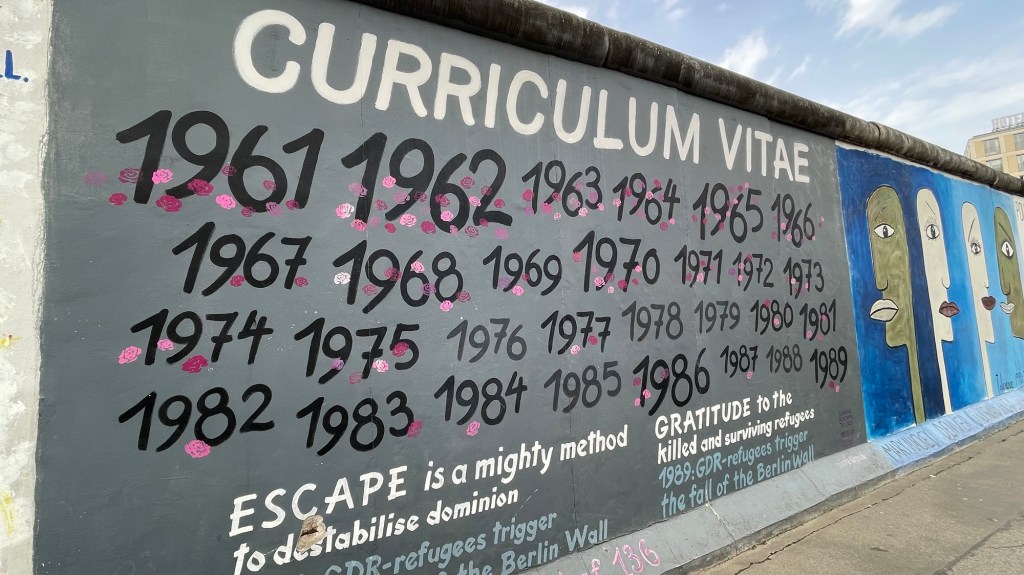
One of the final significant locations of our morning walk was to a surviving section of the Berlin Wall. The original barrier was constructed soon the night of 12-13 August 1961, with East German soldiers constructing more than 30 miles of barbed wire barrier through the heart of Berlin. Later a 155 kilometre long concrete wall surrounded West Berlin until 9 November 1989.

We saw a section that commemorating the deaths of those who tried to escape to the West. Christin provided a lot of personal insights was someone born in Easy Germany just before the fall of the Wall.
We returned to our hotel in the afternoon and Darby and I rested before an afternoon tour of Berlin Underground.
We booked the Dark Worlds tour which is of a bunker used in World War 2. This area was part of the Berlin Gesundbrunnen Train Station which is why it wasn’t destroyed like other bunkers are the war, instead it was walled off. Now there are sections restored by the Society for the Exploration and Documentation of Subterranean Architecture with this Society running tour to fund their mission.

Berlin has had underground structures since the 1820s including as breweries and the pneumatic tube postal service (1865 to 1963). These were repurposed with the Allies bombing of Germany commencing in 1940. As this particular structure was not built as a bomb shelter it would not have survived a direct bomb hit but luckily for the people using it there were no bomb strikes.
The conditions inside were extremely difficult, with low air quality and terrible humidity as regularly the shelter housed 3 to 5 times the recommended limit of people.

I learned a lot during this tour, including that as recently as 1994 three people died during construction when a previously unexploded bomb went offer.
Exploding bombs was very common in the immediate decades after the War. You could also see photos of the destruction of Berlin in the late 1940s and early 1950s that looked like it had been hit the day before not 10 years later.
You really get a feeling of how hard life was for the civilians during and for decades after World War 2.
 Nathan's Insights
Leave a comment